
CME: Pharmacy Benefit Managers (PBMs)

How Do PBMs Control the Prescription Drug Market?
Go to our CME Site, Read Article, Take Test, and Get FREE 🎓CME Certificate with Valid Email
We’ll send you occasional updates. Your email stays private—never sold or shared. 😇
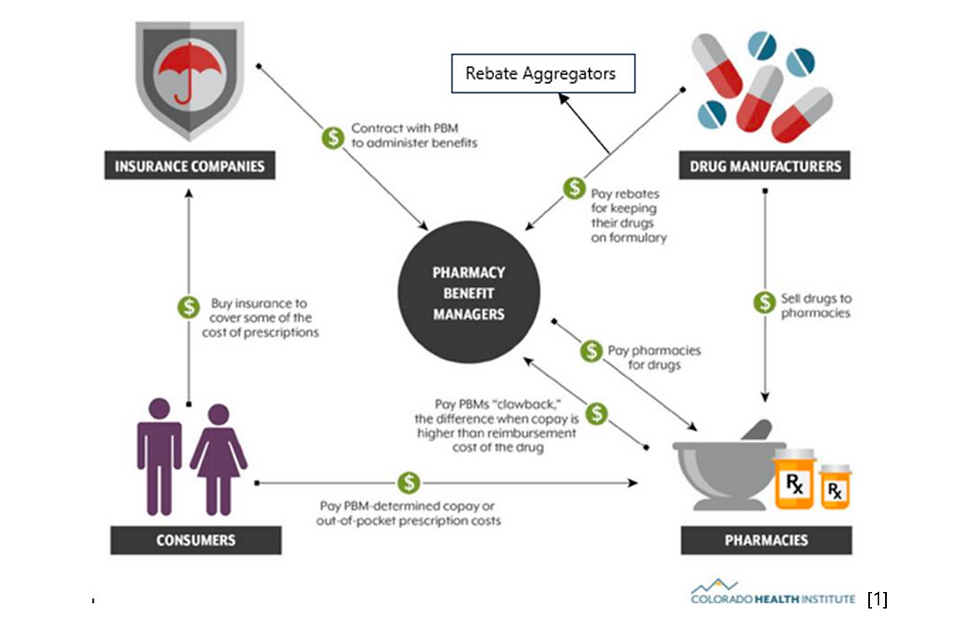
Pharmacy benefit managers (PBMs) are the intermediaries in the U.S. medication distribution system and are positioned to hold down drug costs for insurers and consumers. Industry representatives have stated that their services reduce drug prices.[2] However, PBM business practices have actually been associated with increased drug prices. This article examines the history of PBMs, how they operate within the pharmaceutical industry, and current efforts to limit the extent of their control over drug pricing.
History
Insurance coverage for medical prescriptions began expanding in the 1960s, when only 4% of prescriptions were covered. This increased to 32% by the 1980s. The first PBMs were started by pharmacists in 1965. These pharmacist-led PBMs were controversial with major pharmacy trade organizations complaining about recordkeeping obligations, variability in coverage, and reimbursement rates.[3]
In 1974, the Employee Retirement Income Security Act (ERISA) was passed, creating federal standards for employment-based retirement and health plans. ERISA allowed large employers to adopt cost-containment strategies for their employees, including hiring PBMs to manage their prescription drug benefits.[3]
Vertical integration of PBMs began in 1972 when healthcare companies began acquiring them. In the 1990s, pharmaceutical companies first, followed by pharmacy chains and then insurance companies, started purchasing PBMs. Antitrust inquiries by the U.S. Department of Justice blocked some PBM-involved mergers, but other mergers were permitted.[3]
![Vertical Integration in the Pharmaceutical Industry with Percentages of U.S. Market Share in 2023.[4]](https://static.wixstatic.com/media/ad4816_ab545d9b35d14af690a77655d738afb5~mv2.jpg/v1/fill/w_980,h_657,al_c,q_85,usm_0.66_1.00_0.01,enc_avif,quality_auto/ad4816_ab545d9b35d14af690a77655d738afb5~mv2.jpg)
(Drug private labeler - a company that markets and sells drugs under its own brand name but does not manufacture them. “PBM GPO” Rebate Aggregator – see Negotiations section)
Formulary Design
One of the most important functions of a PBM is the development of a drug formulary that specifies which drugs the PBM will cover and what costs patients will incur. Formularies are described as open, where almost all marketed drugs are available, or as closed which limits drug availability. A PBM may have numerous formularies with differing drug lists, tiers, and costs depending on client preferences. PBM clients can be employers, insurance companies, or public entities such as state Medicaid programs. PBMs also determine the incentives used to encourage use of preferred drugs. If a drug is not on the formulary, a patient may be required to pay the full retail price or attempt to appeal the PBM’s decision.[3]
Prescription Management
PBMs can influence prescribing through various utilization management strategies such as prior authorization, instituting step therapy requirements, limiting dosage or number of days of medication per prescription, or using financial incentives such as levels of deductibles, co-payments, or coinsurance. Prior authorization typically requires the prescribing physician to provide documentation justifying the need for a certain medication before the PBM will approve payment. Step therapy (also known as “fail first”) is the process of requiring a patient to try and fail an approved, typically less expensive medication before a more expensive one is authorized.
With vertical integration, insurance companies may own PBMs and pharmacy chains and strongly incentivize patients to use pharmacies that they own if they want the insurance company to pay for their medications.[3] PBMs can restrict the number of days of medication a patient can receive from a retail pharmacy, aiming to have the patient use an affiliated mail-order pharmacy service. This allows patients to obtain larger quantities of medication at one time from the affiliated pharmacy than from an unaffiliated retail pharmacy, sometimes with reduced copayments.[3]
PBM Negotiations
A PBM negotiates with pharmacies, wholesalers, and drug manufacturers on behalf of its clients. As a result, the price a PBM pays for medications may be lower than manufacturers’ list prices. The actual net prices paid by PBMs are generally not publicly disclosed.[3]
Several issues are problematic in the PBM negotiation process. First, drug manufacturers often pay rebates to the PBMs to have their drugs included on formularies or placed on preferred tiers. These rebates can represent a significant revenue stream for PBMs, and they may or may not end up reducing costs for the consumer. Rebates may incentivize higher list prices and larger price concessions and may lead to higher-cost or brand-name medications being preferred over less expensive, generic or biosimilar alternatives which may generate fewer profits for the PBMs. If a drug manufacturer declines paying requested rebates, or price concessions, its drugs may not be included within the formulary and therefore, will not be covered by patients’ insurance at pharmacies.[3]
Many PBMs and their vertically integrated companies have set up corporate entities called rebate aggregators (or group purchasing organization aggregators). In theory their role is to negotiate better rebate terms with manufacturers by leveraging the prescription volumes of multiple PBMs. In actual practice they provide a method for PBMs to capture and retain rebates in ways that make it difficult for plan sponsors or regulators to determine the true flow of funds. Instead of passing the manufacturers’ rebates directly to the plan sponsor (client), the rebates are paid to the rebate aggregator, where fees, service charges, or other administrative costs may be deducted before the remainder of the rebate is shared with the PBM. The PBM then acts as if it has no knowledge of the rebate aggregator’s actions and can then report drug prices to the plan sponsor without revealing any profits or rebates taken by the rebate aggregator. This lack of transparency allows PBMs to conceal their true cost for drugs from the plan sponsors as well as the true profit margins. This is not an issue for vertically integrated companies as they own each step of the process. However, for smaller insurance companies or companies that self-insure and use PBMs they do not own, it may be problematic. Some rebate aggregators have been incorporated offshore potentially limiting governmental oversight.[5]
PBMs may also retrospectively recoup (claw back) funds from pharmacies if a patient’s copayment exceeds the PBM’s negotiated payment or if contractual performance metrics are not met.[1]
Pharmacy Network
PBMs have the responsibility of creating and maintaining a network of pharmacies for their clients’ employees to obtain their medications. Large PBMs can increase competition between pharmacies by restricting access to the PBM’s pharmacy network, which can result in the pharmacies having to accept lower prices for dispensing medications to achieve network inclusion.[3]
Owning mail-order pharmacies is another way PBMs and insurance companies have vertically integrated. In North America, approximately $37.8 billion in medications were delivered by mail in 2024.[6] Incentives to use PBM-owned mail order pharmacies might be three months of prescription medications instead of one month if filled by a local pharmacy, resulting in a lower copayment for the consumer using mail order.[3]
How Do PBMs Make Money?
PBMs generate revenue through several mechanisms, including:
The ability to retain all or part of the rebates and other price concessions paid to PBMs by drug manufacturers. In the past, the industry average has been for PBMs to retain 0.4% of Medicare Part D and up to 22% of the rebates in the commercial insurance market.
Spread pricing, in which the plan sponsor pays a set price for a drug while the PBM reimburses the pharmacy a lower amount, with the PBM retaining the difference.
Charging administrative fees for its services.[3]
These practices may incentivize maximizing rebates and minimizing pharmacy reimbursement. Larger PBMs with more clients get the most benefit from these strategies, which has led to horizontal integration, where PBMs are merged together or purchased.[3]
Thus, PBMs have placed themselves at the center of the U.S. prescription drug pricing and distribution market and have the ability to control the flow and cost of drugs in all aspects of distribution, directly affecting manufacturers, pharmacies, insurance companies, and consumers.[3]
Issues with PBMs
Concentration of Market Share
There has been a concentration of market share resulting in limited competition. In 2022, three PBM companies (CVS Health - Caremark, Cigna - Express Scripts, and UnitedHealth Group - OptumRx) controlled 79% of the U.S. prescription business. That same year five of the six largest PBMs were owned by health insurers.[7]
Pricing Issues
The PBMs’ use of rebates and fees has incentivized high-cost, high-rebate medications receiving preferred positions on formularies, as these medications are more profitable than lower-priced alternatives. Some PBMs are contractually required to pass 100% of the rebate back to their clients. In response, some drug manufacturers have established a two-price system to secure placement of their medications on PBM formularies: a high-priced, high-rebate option for PBMs permitted to retain rebates, and a lower-priced, no-rebate option for those required to pass rebates through. In 2018, the state auditor of Ohio conducted a one-year review of Medicaid prescriptions. It was reported that PBMs were retaining 31% of Medicaid generic drug prescription prices, 0.8% of brand-name drug prices and 1.1% of specialty drug prices. 86% of the Medicaid prescriptions filled that year in Ohio were for generic medications. Overall, PBMs were earning 8.9% of the total amount spent by Ohio on drugs for Medicaid patients, or $224 million out of a total of $2.526 billion spent.[8]
Another issue with the use of rebates is that the patient’s share of cost for medications is typically based on the list price, not the price minus the rebate. Because patient cost-sharing is typically based on list price rather than post-rebate net price, rebates may lower PBM net costs without proportionately reducing patient out-of-pocket expenses. Increases in drug prices, copayments, or coinsurance can lead patients to forgo filling or picking up their prescriptions. One 2019 review reported that prescription abandonment rates are less than 5% when prescriptions have no out-of-pocket cost, 45% when the cost is over $125 and 60% when the cost is over $500.[9]
The U.S. Department of Health and Human Services’ 2020 Drug Formulary Rebate Rule for Medicare Part D coverage clarified that a patient’s out-of-pocket spending was intended to correlate to the post-rebate price rather than the list price in an effort to address this issue.[3]
Price Transparency
Another criticism of PBMs has been their lack of transparency in reporting pricing, costs and other financial activities. For example, PBMs have the ability to move a drug to a more preferred tier of a formulary, possibly due to a larger rebate, without having to provide any clinical or financial justification. There is also a lack of transparency on how PBMs set pharmacy reimbursement as well as the amount of retroactive pharmacy clawbacks.[3]
Federal Trade Commission (FTC) Interim Report
In 2024, the FTC issued an interim report titled Pharmacy Benefit Managers: The Powerful Middlemen Inflating Drug Costs and Squeezing Main Street Pharmacies. There were several conclusions highlighted in that report:
The market for PBM services has become highly concentrated, and the largest PBMs are now also vertically integrated with the nation’s largest health insurers and specialty and retail pharmacies.
As a result of this high degree of consolidation and vertical integration, the leading PBMs can now exercise significant power over Americans’ access to drugs and the prices they pay.
Vertically integrated PBMs may have the ability and incentive to prefer their own affiliated businesses, entering into complex and opaque contractual relationships, which can, in turn, disadvantage unaffiliated pharmacies and increase prescription drug costs.
PBMs and brand drug manufacturers sometimes negotiate prescription drug rebates that are expressly conditioned on limiting access to potentially lower cost generic alternatives.[4]
An audit of two cancer drugs in the report found that pharmacies owned by commercial health plans were paid by their affiliated PBMs 80% to 90% more than unaffiliated pharmacies for dispensing those drugs. Medicare Part D plans paid 30% more to insurance company affiliated pharmacies than unaffiliated ones for those two medications.[4]
The report concluded that higher payments to pharmacies in vertically integrated companies allow them to game regulations. Medical loss ratios (MLRs) are regulated under the Affordable Care Act and represent the percentage of collected premium revenue that health plans are required to spend on clinical care and quality improvement initiatives (typically 80 to 85 percent). If an insurer pays an inflated price for medication to its own affiliated pharmacy, the higher payment is credited as spending for clinical care and helps the insurer satisfy its MLR obligations. The higher payments may increase the pharmacy’s profits which eventually flow back to the insurer owner. In addition, the higher cost of the medications allows the PBM to bill unaffiliated insurers or self-insured employers for higher drug costs, even though they have recaptured that money in their pharmacies. Inflated drug costs for Medicare Part D plans move recipients into the phase where the government covers drug expenses faster and can increase Medicare expenses, which may lead Medicare Advantage plans to request increased reimbursement from Medicare the following year.[4]
Copay Coupons and Alternative-funding Plans
Many drug manufacturers provide copay coupons for their higher-cost medications (most often dispensed from specialty pharmacies) to help defray out-of-pocket costs for consumers who use their medications. This has led to several strategies by PBMs to increase profits that are not necessarily in a patient’s best interests.
With a copay accumulator program, the value of a manufacturer’s copay coupon is paid to the PBM each time a prescription is filled but that amount does not decrease an enrollee’s deductible or out-of-pocket maximum. This results in the PBM essentially getting paid twice, once by the coupon and then later by the patient for a future prescription as the coupon has not been applied to reduce the patient’s deductible. When the patient’s eligibility for these coupons has reached the maximal yearly amount permitted, the enrollee may then be subject to deductibles and co-payments, which may be very expensive.[10]
For a copay maximizer program, the value of the copay coupons is spread out evenly over the year and is not used to reduce the copay or insurance deductible for the patient, resulting in double payments to the PBM.[10]
For both of these programs, the PBM or insurance company is paid part or all the patient copays but does not use those funds to decrease patients’ yearly deductibles. This has the effect of raising profits and increasing patients’ out-of-pocket costs.[11]
In alternative funding plans, to decrease costs, the employer and the PBM remove some high-cost drugs from the formulary in a cost-shifting strategy. An enrollee who needs the medication is referred to third-party vendors called alternative funding vendors who attempt to find manufacturer programs or charities to defray the costs. This practice can lead to delays, increased paperwork and there is no guarantee that the enrollee will actually be able to receive coverage for the medication.[12]
Legislation and Administrative Actions
In response to the perception that PBMs have too much control over the pharmaceutical distribution system, are making excessive profits, and lack price transparency, some states have passed legislation or changed administrative policies to limit their power.
In 2017, West Virginia stopped using PBMs to administer pharmacy benefits for state workers and Medicaid beneficiaries. The State’s Bureau for Medical Services’ Office of Pharmacy Services (OPS) started acting as its own PBM. West Virginia estimated that its Medicaid managed care program would save $38 million in the first year,[13] but it actually saved $54.4 million.[14]
In 2021, West Virginia passed legislation, House Bill 2263, which mandated that any rebates PBMs received from drug manufacturers be passed on to patients. For example, if a drug’s list price was $100 and the PBM got a $40 rebate from the manufacturer the drug would actually cost the PBM $60. However, typically before this law was passed patients who had not met their deductible would still pay the list price of $100, leaving the PBM with an additional $40 profit on top of its normal fees. After the passage of House Bill 2263, the PBM can only charge the patient $60, passing the rebate directly to them.[15]
In 2025, the West Virginia insurance commissioner released a report on the effect the PBM rebate legislation had on insurance premiums. As can be seen in the chart below, the rebate pass-through for almost every insurer listed reduced the amount of rate increase the insurers requested for the following year.[16]
2024 Filings (2025 Plan Year)
![West Virginia Insurance Rate Increase Requests for 2025[16]](https://static.wixstatic.com/media/ad4816_4a6e23a40fa3420fa85f0e007bb1dfcb~mv2.jpg/v1/fill/w_980,h_519,al_c,q_85,usm_0.66_1.00_0.01,enc_avif,quality_auto/ad4816_4a6e23a40fa3420fa85f0e007bb1dfcb~mv2.jpg)
In Arkansas, in 2025, House Bill 1150 (now Act 624) was passed. This was an attempt to protect the interests and viability of independent pharmacies in the state and aimed to reduce conflicts of interest and promote more competition. The bill prohibited PBMs from owning or operating pharmacies. However, legal battles and a court injunction have thus far prevented its implementation.[17]
In Massachusetts, a law was enacted in 2025 called the PBM Licensing and Transparency Law (Senate bill 3012), which required PBMs to be registered, and included requirements of detailed reporting and oversight mechanisms for PBMs operating within the state.[17]
California and Colorado passed delinking laws (Senate Bill 41 and House Bill 1094), which alters how PBMs are compensated. These prohibit PBM remuneration being tied to the price of drugs, and transitions PBM compensation to a flat administrative fee model. This aims to remove incentives for PBMs to favor higher-priced medications for their formularies due to the higher rebates.[17] The California law also attempts to increase transparency as it requires PBMs to report payments and rebates received from manufacturers to pharmacies and health plans. It ensures manufacturers’ rebates are passed on to payers and patients and prohibits PBMs from steering patients to their own affiliated pharmacies.[18]
Similar legislation regulating PBMs has been introduced in other states.
Recent Federal Reactions to PBM Practices
There has been recent activity with regard to PBM practices from the federal government. In April 2025, as a presidential executive order regarding lowering drug prices, several governmental agencies were asked to research how best to promote a more competitive, efficient, transparent, and resilient pharmaceutical value chain to deliver lower drug prices for Americans.[19]
In response to that presidential order, on January 30, 2026, the Department of Labor’s Employee Benefits Security Administration published proposed regulations intended to increase PBM transparency for private companies, unions, and employee organizations offering insurance plans to employees regulated under ERISA (Employee Retirement Income Security Act). The proposed regulations included increasing PBM transparency for drug pricing and profit margins, disclosing formulary placement incentives and arrangements with manufacturers, and having the PBM act as an ERISA fiduciary and disclose any conflicts of interest.[20,21]
On February 3, 2026, the Consolidated Appropriations Act was signed into law. Part of that budgetary agreement included regulations for PBMs requiring the following:
Transparency and improved reporting of Medicare Part D drug prices.
Requiring Part D insurance plans to allow any pharmacy that meets specified criteria to participate in a PBM’s network. The law also establishes a method for pharmacies to report contract-related violations without fear of retaliation and authorizes enforcement actions and penalties against insurance plans or PBMs that fail to comply with the rules.
Increased price transparency for prescription drugs purchased by employer health plans which requires PBMs to provide detailed data on prescription drug spending, drug rebates, spread pricing arrangements, drug formulary placement rationale, and information about financial relationships with their affiliated pharmacies.[22]
On February 4, 2026, the Federal Trade Commission (FTC) secured a settlement with Express Scripts, one of the largest PBMs, that at this writing is awaiting comments from the public before acceptance. The FTC sued Express Scripts for inflating the price of insulin by using anticompetitive and unfair rebating practices, impairing patients’ access to lower list price products, and ultimately shifting the cost of high insulin list prices to patients. The FTC expects to drive down patients’ out-of-pocket costs for drugs like insulin by up to $7 billion over 10 years and bring millions of dollars in new revenue to community pharmacies. As part of the settlement, Express Scripts has agreed to improve transparency on drug pricing, use lower-cost alternatives rather than high-cost versions, stop using inflated list prices to calculate patients’ out-of-pocket costs, move its rebate aggregator (GPO) from Switzerland to the U.S., treat community pharmacies more fairly, lower out-of-pocket costs for insulin and allow sponsor access to TrumpRx.[23] TrumpRx is a website that was recently instituted where patients with commercial insurance may receive coupons for these lower-priced drugs to present to local pharmacies.[24]
Effect of Direct-to-Consumer Pharmacies and Price Limits on Certain Drugs
There have been some recent changes in the pharmaceutical industry that are affecting the power of PBMs. One has been the rise of direct-to-consumer mail-order pharmacies. Some sell only generic medications at a minimal markup, while others sell a wider selection of drugs.[3] The Centers for Medicare & Medicaid Services (CMS) also began negotiating prices with drug manufacturers for Medicare Part D. Ten drugs for 2026 and fifteen for 2027 have been selected that have no biosimilar or generic versions and CMS estimates that Medicare savings could approach 44% or $12 billion a year on those drugs.[25,26]
Summary
PBMs were originally created to manage prescription drug benefits and control costs. However, vertical and horizontal integration, rebate-driven revenue models, and limited pricing transparency appear to have contributed to higher drug prices and increased costs for patients, governmental entities, and insurance plan sponsors that are not affiliated with PBMs.
State and federal reforms are increasingly targeting PBM rebate structures, pricing models, transparency, relationships with community pharmacies, vertical integration, and fiduciary responsibilities.
Ongoing regulatory and legislative efforts may significantly reshape PBM operations and the U.S. pharmaceutical distribution system in the coming years.
Author’s Note: Thank you to Dr. Theodor Feigelman for editing this learning activity.
✅ Earn Free CME Credit for Reading this Article on Our CME Site
Eligible for 0.75 PRA Category 1 Credit
Click the button below to complete the course and take a short quiz.
A valid email is required to send your certificate.
We’ll send you occasional updates. Your email stays private—never sold or shared. 😇
References
[1] Understanding Pharmacy Benefit Managers. Courtesy of the Colorado Health Institute, www.ColoradoHealthInstitute.org, 1999 Broadway, Suite 600, Denver, CO 80202. Last updated: March 10, 2023. Retrieved from: https://www.coloradohealthinstitute.org/research/understanding-pharmacy-benefit-managers
[2] Medicare Part D: Use of Pharmacy Benefit Managers and Efforts to Manage Drug Expenditures and Utilization (GAO-19-498). U.S. Government Accountability Office. July 2019. Retrieved from: https://www.gao.gov/assets/gao-19-498.pdf?utm_source=chatgpt.com
[3] Mattingly TJ, Hyman DA, Bai G. Pharmacy Benefit Managers: History, Business Practices, Economics, and Policy. JAMA Health Forum. 2023;4(11). Retrieved from: https://jamanetwork.com/journals/jama-health-forum/fullarticle/2811344
[4] Pharmacy Benefit Managers: The Powerful Middlemen Inflating Drug Costs and Squeezing Main Street Pharmacies. U.S. Federal Trade Commission Office of Policy Planning. July 2024. https://www.ftc.gov/system/files/ftc_gov/pdf/pharmacy-benefit-managers-staff-report.pdf
[5] A Turning Point for Fiduciary Accountability: PBM-Owned Rebate Aggregators in the Spotlight. Buchanan Ingersoll & Rooney PC. Sept. 10 2025. Retrieved from: https://www.bipc.com/a-turning-point-for-fiduciary-accountability-pbm-owned-rebate-aggregators-in-the-spotlight
[6] Mail Order Pharmacy Market Trends, Opportunities and Strategies, 2019-2024 & 2025-2034: CVS Health Leads the $550 Billion Fragmented Market, Followed by Walmart Pharmacy and Kroger Health. Globe Newswire. Feb. 21, 2025. Retrieved from: https://finance.yahoo.com/news/mail-order-pharmacy-market-trends-104800922.html
[7] Fein AJ. The Top Pharmacy Benefit Managers of 2022: Market Share and Trends for the Biggest Companies. Drug Channels. May 23, 2023. Retrieved from: https://www.drugchannels.net/2023/05/the-top-pharmacy-benefit-managers-of.html
[8] Auditor’s Report: Pharmacy Benefit Managers Take Fees of 31% on Generic Drugs Worth $208M in One-Year Period. Press Release • Ohio Auditor of State. August 16, 2018. Retrieved from: https://ohioauditor.gov/news/pressreleases/details/5042
[9] Medicine Spending and Affordability in the U.S. IQVIA. Aug 04, 2020. Retrieved from: https://www.iqvia.com/insights/the-iqvia-institute/reports-and-publications/reports/medicine-spending-and-affordability-in-the-us
[10]Long M et al. Copay Adjustment Programs: What Are They and What Do They Mean for Consumers? KFF. Oct 24, 2024. Retrieved from: https://www.kff.org/health-costs/copay-adjustment-programs-what-are-they-and-what-do-they-mean-for-consumers/
[11] Copay Maximizers. MMIT. Retrieved from: https://www.mmitnetwork.com/glossary/copay-maximizers/
[12] Gliadkovskaya A. A new wave of middlemen offers 'alternative funding' for specialty drugs. Patients bear the risks. Fierce Healthcare. Last updated on October 24, 2025. Retrieved from: https://www.fiercehealthcare.com/payers/new-wave-middlemen-promise-savings-specialty-drugs-patients-bear-risks
[13] States Take Administrative Actions to Curb Medicaid Drug Costs. The National Academy for State Health Policy. 10/16/18. Retrieved from: https://nashp.org/states-take-administrative-actions-to-curb-medicaid-drug-costs/
[14] West Virginia Medicaid saves $54.4 million with prescription drug carve-out. National Community Pharmacists Association. March 13, 2019. Retrieved from: https://ncpa.org/newsroom/news-releases/2019/03/13/west-virginia-medicaid-saves-%2454.4-million-with-prescription-drug-carve-out#:~:text=In%20July%202017%2C%20the%20West%20Virginia%20Medicaid,West%20Virginia%20*%20Fair%20reimbursement%20for%20pharmacies
[15] Laganga S. West Virginia becomes the first state to lower patient costs by sharing the savings. PhRMA. April 20, 2021. Retrieved from: https://phrma.org/blog/west-virginia-becomes-the-first-state-to-lower-patient-costs-by-sharing-the-savings
[16] McVey AL, Insurance Commissioner. Prescription Drug Rebate Impact to Commercial Health Insurance. West Virginia Insurance Bulletin No. 25-01. February 13, 2025. Retrieved from: https://www.wvinsurance.gov/Portals/0/pdf/pol_leg/IB_25-01_Prescription_Drug_Rebate_Impact_to_Commercial_Health_Insurance.pdf
[17] Kimbrough L. State Pharmacy Benefit Management Reform in 2025. Multistate. October 23, 2025. Retrieved from: https://www.multistate.us/insider/2025/10/23/state-pharmacy-benefit-management-reform-in-2025
[18] Senate Bill No. 41. California Legislative Information. 10/13/2025 Retrieved from: https://leginfo.legislature.ca.gov/faces/billNavClient.xhtml?bill_id=202520260SB41
[19]A Presidential Document by the Executive Office of the President. Lowering Drug Prices by Once Again Putting Americans First. Federal Register. 04/18/2025. Retrieved from: https://www.federalregister.gov/documents/2025/04/18/2025-06837/lowering-drug-prices-by-once-again-putting-americans-first
[20] Welle NJ et al. DOL Proposes Sweeping New Disclosure Rules for Pharmacy Benefit Managers. The National Law Review. February 2, 2026. Retrieved from: https://natlawreview.com/article/dol-proposes-sweeping-new-disclosure-rules-pharmacy-benefit-managers
[21] Improving Transparency into Pharmacy Benefit Manager Fee Disclosure. Department of Labor. 01/30/2026. Retrieved from: https://public-inspection.federalregister.gov/2026-01907.pdf
[22] A New Era for Patients: Carter celebrates President Trump signing PBM reforms into law. Buddy Carter Press release. February 3, 2026. Retrieved from: https://buddycarter.house.gov/news/documentsingle.aspx?DocumentID=16308
[23] FTC Secures Landmark Settlement with Express Scripts to Lower Drug Costs for American Patients. FTC. February 4, 2026. Retrieved from: https://www.ftc.gov/news-events/news/press-releases/2026/02/ftc-secures-landmark-settlement-express-scripts-lower-drug-costs-american-patients
[24] TrumpRX. Retrieved from: https://trumprx.gov/
[25] Medicare Drug Price Negotiation Program: Negotiated Prices for Initial Price Applicability Year 2026. CMS. August 2023. Retrieved from: https://www.cms.gov/files/document/fact-sheet-medicare-selected-drug-negotiation-list-ipay-2026.pdf
[26] Medicare Drug Price Negotiation Program: Negotiated Prices for Initial Price Applicability Year 2027. November 2025. CMS. Retrieved from: https://www.cms.gov/files/document/fact-sheet-negotiated-prices-ipay-2027.pdf