
The Discovery of Radium and the Start of the “Radium Cure Craze” Era

Updated: Sep 18

In 1898, Marie and Pierre Curie discovered and isolated the radioactive element radium from uranium ore. Previously, Marie Curie had coined the term “radioactivity” to describe the emissions of uranium first described by Henri Becquerel. Those three scientists were awarded the Nobel Prize in Physics in 1903 for their study of radiation, and in 1911 Marie Curie was awarded the Nobel Prize in Chemistry for her discovery of the elements radium and polonium.
The “Radium Cure Craze” Era
The discovery of radium led to an era known as the “radium cure craze” or “radium mania”, during which many commonly sold items, such as hair products, toothpaste and cosmetics, promised almost magical disease cures and included radium as an ingredient. The exciting prospect of this mysterious, newly discovered radioactive substance helping to treat many of mankind’s ills was tantalizing to the public. The dangers of radiation exposure were not yet understood, and the radium business flourished. Radium was expensive at that time, and many of the products sold were fraudulently marketed as containing radium. This may have been fortunate as it limited the public’s exposure and reduced the ultimate number of radium victims.

The New York Times published a story in 1908 that the price of radium was then $40 million per pound. ($1.4 billion today)
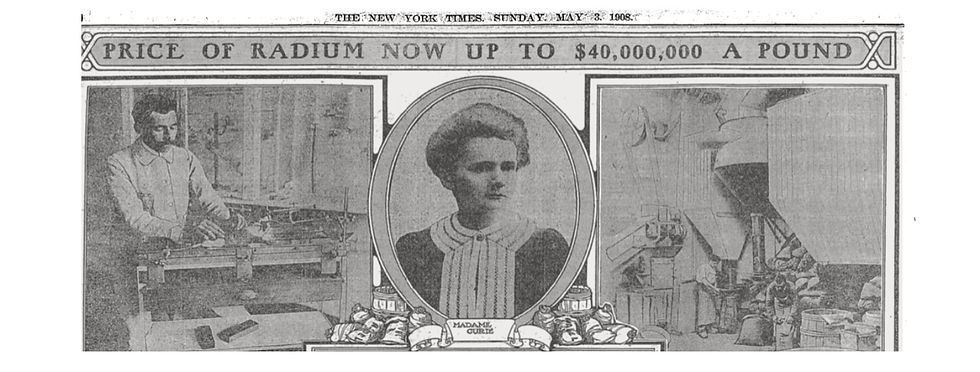
In the early 1900s, the New York Times started publishing true stories about radium curing cancers, which only increased its mystique as a miracle cure. The Mild Radium Therapy movement was a phenomenon occurring shortly after the Curies discovered radium. Followers believed that radiation, taken in minute doses, gave a metabolic boost to the body's endocrine system and infused organs with energy.


Radium Water
Ceramic water dispensers with some radium blended into the walls were sold to allow users to get the benefit of the miraculous cure. Trace amounts of radium were discovered in some mineral water at spa resorts and marketed as a bathing cure-all.
The “Afternoon Radium Cure”

In Paris, in 1911, the “Afternoon Radium Cure” was a fad where people spent a few hours playing bridge, reading, and talking, while breathing in radium mist. There was a device in a well-appointed drawing room where oxygen was passed through a reservoir containing several thousand dollars’ worth of radium. The mist was then dispersed throughout the room by a small electric fan. A New York Times article noted that although the establishment had only been open a few days it was already “the talk of Paris”, and “it is astonishing how many society women have suddenly discovered that they are suffering from rheumatism in order not to miss the 3 to 5 o’clock Radium Tea.”
Patent Medicines
Patent medicines began to be marketed, such as Radol and Radithor claiming to cure a multitude of diseases. Radol was later found to have no radium in it, and banned from the marketplace, but Radithor did contain real radium and became part of a larger story.


Public Sentiment Starts to Shift
Radithor was a health drink marketed by entrepreneur William J. A. Bailey, which contained radium and was promoted as a cure for more than 150 ailments, as well as an aphrodisiac. It cost $1 a bottle (about $18.63 today), and only the affluent could afford to use it regularly. It contained distilled water with one microcurie each of two radium isotopes. He ended up selling 400,000 bottles of Radithor (worth about $7.45 million today).
In 1927, a wealthy steel mogul and socialite named Eben MacBurney Byers fell while travelling by train and injured his arm. After which, to try to get pain relief, a doctor recommended he try Radithor. He liked it so much (in addition to the pain relief, there are rumors the “supposed aphrodisiac effect” was also a factor), that he began drinking two to three bottles a day for the next few years. It has been estimated he drank over 1,400 bottles. He sent cases of Radithor to business associates and girlfriends and even fed it to his racehorses. He finally quit in 1930 after he started complaining about headaches, weight loss, losing his “toned-up feeling” and teeth falling out. U.S. regulatory agencies in that era were more concerned with truth in advertising than about potential harmful effects. The Federal Trade Commission (FTC) took action against makers of patent medicines that lacked their advertised levels of radioactivity. By 1930 the FTC started investigating the issue of whether radium was actually harmful. As Mr. Byers’s case had gained significant publicity, he was asked to testify at a hearing in 1931 but was too ill to do so. An FTC lawyer sent to take a deposition at his house was horrified to find that most of Byers’s jaw had been removed and holes were forming in his skull. As radium is similar in composition to calcium, the human body cannot distinguish between them. After radium exposure, the isotope is incorporated into a person’s bones, where it produces harmful effects. Later that year the FTC shut down Radithor production. In March of 1932, Byers died of radium poisoning, and his publicized death marked the end of the radium patent medicine era. Due to his body’s radioactivity, he was buried in a lead-lined coffin.
Marie Curie died of radiation-induced aplastic anemia in 1934, and due to her constant exposure to radioactive materials her body was radioactive and also had to be buried in a lead-lined coffin. Her radioactive books and possessions were stored away, possibly for thousands of years, in lead-lined containers. While some isotopes of radium have half-lives measured in days, radium-226 has a radioactive half-life of about 1,600 years.
The “Radium Girls”

In 1917, women started working at the United States Radium Corporation plant in Orange, New Jersey. They used radium-infused paint to coat watch dials and military instruments so they would glow in the dark. In 1922, another factory was opened by the Radium Dial company in Ottawa, Illinois, to make watches for the general public. The women were instructed to point their paintbrush tips by licking them to get the best results, while they painted the numbers and watch hands on the dials. They were not warned about any danger but then they began to suffer severe symptoms, including anemia, deterioration of their jaw bones (known as radium jaw), and deadly cancers. Five women who had worked at the United States Radium Corporation plant sued the company in a widely publicized case, in which they were called the “Radium Girls” by the press. The case was eventually settled out of court with a payment of $10,000 ($189,000 today), a $600 yearly annuity and payment of all medical and legal expenses for each of the five women.

Women at the Radium Dial company then decided to sue and that case, after much litigation, including appeals going up to the U.S. Supreme Court, was won by the women. Connecticut’s Waterbury Clock Company also settled claims with 16 workers. It is thought that over 100 women died from radiation poisoning from radium clockmaking.
In the 1930s, as the dangers of radium became more well-known, radium was voluntarily discontinued from consumer products such as toothpaste and cosmetics. In 1938, The U.S. Federal Food, Drug, and Cosmetic Act banned radioactive consumer products. However, radium was still used in some watches and airplane controls until the 1960s. In 1968, a formal ban on using radium in consumer watch products was implemented in the United States, and in the early 1970s its use in aircraft dials was stopped.
The publicity of the “Radium Girls’” plight led to the Illinois Occupational Diseases Act, which took effect in 1936. It included provisions requiring employer coverage for industrial poisonings. It has been suggested that the Illinois Occupational Diseases Act was a steppingstone that eventually led to the creation of OSHA (Occupational Health and Safety Administration) to protect workers’ rights.

Summary
The discovery of radium led to an era of unbridled enthusiasm for its ability to cure disease. The damaging effects of radiation were still mostly unknown and led to radium being marketed fraudulently as a cure for many diseases.

Radium was able to cure some cancers but has been replaced in modern cancer treatment by other man-made radioactive isotopes that are safer to use and easier to manufacture.
As the stories of Eben Byers, the “Radium Girls”, and even Marie Curie illustrate, the unfortunate effects of radium exposure were not fully appreciated until later on. The plight of the “Radium girls” led to legislation that provided greater protection for workers.
If you liked this article, here are more fascinating topics in the FibonacciMedicine history of medicine series:
Interesting Medical Stories
Milestones in Medicine
Medical Fads
Medical Conmen
Diseases
References
This Month in Physics History, December 1898: The Curies Discover Radium. The American Physical Society. https://www.aps.org/archives/publications/apsnews/200412/history.cfm
Santos LJ. Half Lives: The Unlikely History of Radium. July 4, 2020. Retrieved from: https://we-make-money-not-art.com/half-lives-the-unlikely-history-of-radium/
Cinémagazine, 14 février 1935 – https://gallica.bnf.fr/ark:/12148/bpt6k2000628h, CC BY-SA 4.0, https://commons.wikimedia.org/w/index.php?curid=97956453
Price of Radium Now Up to $40,000,000 a Pound. The New York Times. May 3, 1908. Retrieved from: https://timesmachine.nytimes.com/timesmachine/1908/05/03/issue.html
RADIUM AS A CANCER CURE.; Astonishing Results Obtained in the Case of a Patient Whose Condition Apparently Was Hopeless. The New York Times. Dec. 30, 1903. Retrieved from: https://www.nytimes.com/1903/12/30/archives/radium-as-a-cancer-cure-astonishing-results-obtained-in-the-case-of.html
Tells of Cancer Cures by Radium. The New York Times. January 31, 1910. https://timesmachine.nytimes.com/timesmachine/1910/01/31/105985215.html?pageNumber=8
Radium Cure a Fad of Paris Society. The New York Times December 10, 1911. Retrieved from: https://timesmachine.nytimes.com/timesmachine/1911/12/10/100342941.html?pageNumber=39
Radol. The Museum of Radium. Retrieved from: http://museumofradium.co.uk/radol/
Tontonoz M. Hot Times in “Radium Hospital”: The History of Radium Therapy at MSK. September 22, 2016. https://www.mskcc.org/news/hot-times-radium-hospital-history-radium-therapy-msk
Tasch B. Marie Curie's Belongings Will Be Radioactive for Another 1,500 Years. Science Alert. 27 August 2015. Retrieved from: https://www.sciencealert.com/these-personal-effects-of-marie-curie-will-be-radioactive-for-another-1-500-years
Everline T. Radium Hound. The Magazine on Medium. Feb 26, 2014. Retrieved from: https://medium.com/the-magazine/radium-hound-85d9bac2d95d
Beese J. “The Radium Water Worked Fine Until His Jaw Came Off” . The Diary of an Anatomist, a Fistful of Neurons. May 9, 2018. Retrieved from: https://afistfulofneurons.com/radium-water-radithor/
“The Radium Water Worked Fine Until His Jaw Came Off.” The Wall Steet Journal. August 1990. Retrieved from: https://web.archive.org/web/20181214144013/http://case.edu/affil/MeMA/MCA/11-20/1991-Nov.pdf
Radium dial painter - public domain photo - Wikimedia Commons [commons.wikimedia.org]
Balkansky A. Radium Girls: Living Dead Women. Library of Congress Blogs. March 19, 2019. Retrieved from: https://blogs.loc.gov/headlinesandheroes/2019/03/radium-girls-living-dead-women/
“Five Women Doomed to Die,” The World (New York, NY), May 10, 1928, p. 14. Retrieved from: https://blogs.loc.gov/headlinesandheroes/2019/03/radium-girls-living-dead-women/
“Hear Case of Dying Woman,” Worcester Democrat and the Ledger-Enterprise (Pocomoke City, MD), March 4, 1938, p. 9. Retrieved from: https://blogs.loc.gov/headlinesandheroes/2019/03/radium-girls-living-dead-women/
“Radium to Extend Life to 100 Years,” The New York Herald, October 14, 1921, p. 1. Retrieved from: https://blogs.loc.gov/headlinesandheroes/2019/03/radium-girls-living-dead-women/
Morgan Kate. The Radium Girls' Dark Story Still Glows with Death and Deceit. Updated: Jun 7, 2024. https://history.howstuffworks.com/historical-events/radium-girls.htm
Friedman J. How the Radium Girls Forced Workplace Safety Reforms. History. Last Updated: August 11, 2025. Retrieved from: https://www.history.com/articles/radium-girls-workplace-safety